

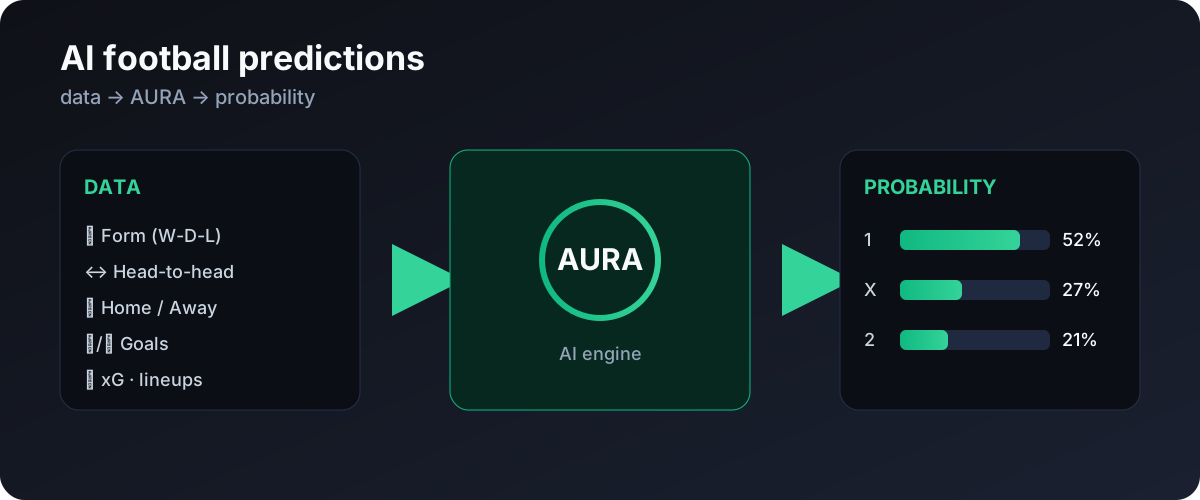
AI Football Predictions Explained: The Complete Guide to How AURA Models a Match
AI football predictions have moved from a niche curiosity to a core part of how fans research a fixture. This complete guide explains what an AI football prediction actually is, how the AURA engine models a match from form, head-to-head and dozens of other statistical factors, which markets it covers, and — crucially — how to read a probability without mistaking a likelihood for a certainty. Everything here is informational and free.
What Are AI Football Predictions?
An AI football prediction is a data-driven estimate of how likely each outcome of a match is, produced by a model that reads large volumes of structured football data and turns it into probabilities. Rather than a pundit offering an opinion, an AI prediction engine processes recent results, goals data, league standings, head-to-head records and team news, then expresses its view as numbers — for example, a 48% chance of a home win, a 27% chance of a draw and a 25% chance of an away win.
On SportPicker, that engine is called AURA. It is the system behind the football predictions you see on the predictions page, the daily pick and each individual match page. AURA does not 'know' who will win — no system can. What it does is weigh the evidence consistently, without the emotional bias that affects human tipsters, and present a structured probability for every market it covers. The goal is to give football fans a clearer, faster picture of a fixture so they can form their own view.
It helps to be precise about language. A prediction in this context is a probabilistic forecast, not a promise. When AURA suggests a likely scoreline or a favoured outcome, it is summarising where the statistical weight sits on the day the analysis is generated. The match is still played on grass, and football is famous for upsets. That tension — strong signal versus genuine uncertainty — is the heart of this guide, and we return to it throughout.
How AI Predictions Differ From Traditional Tips
Traditional football tips often rest on reputation, recent narrative and gut feeling. AI football predictions are different in three important ways. First, they are systematic: the same factors are evaluated for every fixture, every time, so a small team gets the same analytical treatment as a giant. Second, they are transparent about uncertainty, because the output is a probability rather than a flat 'this team wins'. Third, they are reproducible: given the same inputs, the model reaches the same conclusion, which makes the reasoning easier to inspect and trust.
This does not make AI predictions automatically 'better' than expert analysis — they are simply a different tool. The strongest approach for any fan is to combine an engine like AURA with their own knowledge of the teams, the competition context and anything the data cannot see, such as dressing-room morale or a manager resting players before a cup tie.
Throughout this guide, every figure is illustrative and every prediction is a probability, not a guarantee. AURA is provided for information and entertainment only. It is not betting advice, and nothing here is an invitation to bet.
How the AURA Engine Models a Match
AURA builds its view of a fixture by assembling many independent signals and weighing them together. No single factor decides a prediction; instead, the engine looks for where multiple indicators agree or disagree. When several strong signals point the same way, the probability for that outcome rises. When the evidence is mixed — a strong home side facing in-form away opponents with key injuries on both sides — the probabilities flatten, correctly reflecting a genuinely uncertain match.
Below are the principal factors the engine considers. Each is drawn from structured football data supplied by specialist sports-data providers, then normalised so that teams across different leagues can be compared on a consistent basis.
Recent Form
Form captures momentum: how a team has performed across its most recent matches. AURA reads the run of wins, draws and losses, but it also looks beneath the result — were victories comfortable or narrow, were defeats heavy, did performances flatter or flatter to deceive? A team on a five-match winning streak carries a different weight to one that has limped to three single-goal wins against weak opposition. Form is powerful but decays quickly, so the most recent fixtures count more than older ones.
Head-to-Head Record
Some fixtures have a stubborn pattern. Head-to-head (H2H) history records how these two specific teams have fared against each other, which can reveal stylistic match-ups that league position alone hides — a mid-table side that consistently frustrates a particular top-six team, for instance. AURA factors recent meetings in, while discounting very old results played by largely different squads.
Home and Away Performance
Home advantage is real and measurable, but it varies enormously by club. AURA separates each team's home record from its away record rather than using a single blended rating. A side that is formidable at home but fragile on the road will be modelled accordingly, which is why the same team can carry very different probabilities depending on the venue.
Goals Scored and Conceded
Attacking output and defensive solidity are central to every market. The engine examines goals scored and goals conceded — both totals and rates per match, split by home and away — to estimate how many goals each team is likely to produce and allow. These goal expectations feed directly into Over/Under, Both Teams to Score and Correct Score, and they shape the 1X2 picture too: a leaky defence dents even a strong attacking side's win probability.
Injuries, Suspensions and Probable Lineups
Team news can swing a match. AURA ingests known injuries and suspensions and considers probable lineups, recognising that the absence of a first-choice striker or a key central defender materially changes a team's expected performance. Because team news evolves up to kick-off, this is one reason predictions are best read close to the match and treated as a snapshot in time.
League Standings and Context
Where teams sit in the table, their points, goal difference and the stakes of the fixture all add context. A relegation six-pointer or a title decider carries different dynamics to a dead rubber. Standings give the engine a structural baseline of quality that complements the more volatile form signal.
On top of these headline inputs, AURA weighs dozens of finer statistical factors derived from the same data — scoring distributions, clean-sheet frequency, the balance between first-half and second-half goals, and consistency across recent matches. The table below summarises the main families of signals and what each one contributes.
| Factor | What it measures | Primary influence |
|---|---|---|
| Recent form | Momentum across the latest matches | 1X2, confidence level |
| Head-to-head | Pattern between these two specific teams | 1X2, draw likelihood |
| Home/away split | Venue-specific performance | 1X2, all markets via venue |
| Goals scored/conceded | Attacking output and defensive record | Over/Under, BTTS, Correct Score |
| Injuries & suspensions | Availability of key players | Squad strength, all markets |
| Probable lineups | Likely starting eleven and shape | Fine-tunes goal expectations |
| League standings | Structural quality and stakes | Baseline strength, context |
Which Markets AURA Covers
A single match can be viewed through several different questions, and each question is a 'market'. AURA produces probabilities across the most widely followed football markets so that fans can explore a fixture from more than one angle. Understanding what each market actually asks is the first step to reading any prediction sensibly.
The Core Markets, Explained
- 1X2 (Match Winner): the classic three-way market — home win (1), draw (X) or away win (2). It is the backbone of most predictions and the one most fans look at first.
- Double Chance: combines two of the three 1X2 outcomes (home or draw, away or draw, or home or away). Because it covers two results, it carries a higher probability and lower variance than a single 1X2 pick.
- Over/Under (Total Goals): asks whether the combined goals in the match will be above or below a line such as 1.5, 2.5 or 3.5. Lines like Over 1.5 and Under 3.5 are inherently more stable than the popular 2.5 line.
- Both Teams to Score (BTTS): a yes/no question on whether each team scores at least once. It depends heavily on the attacking and defensive profiles of both sides.
- Correct Score (Exact Score): the most specific market — naming the precise final scoreline. Because there are many plausible scores, even the single most likely one usually carries a modest probability.
The table below shows the typical question, granularity and inherent variance of each market. Granularity matters: the more specific the market, the more ways it can be wrong, and the lower the probability attached to any single outcome — even when the underlying read is strong.
| Market | The question it answers | Specificity | Typical variance |
|---|---|---|---|
| 1X2 | Who wins, or is it a draw? | Medium | Medium |
| Double Chance | Will one of two outcomes land? | Low | Lower |
| Over/Under | More or fewer goals than the line? | Medium | Medium (depends on line) |
| BTTS | Do both teams score? | Medium | Medium |
| Correct Score | What is the exact scoreline? | Very high | High |
Why Some Markets Are More Reliable Than Others
There is a natural trade-off between specificity and reliability. Double Chance and a wide Over/Under line cover more ground, so they land more often, but each outcome reveals less. Correct Score is the opposite: thrilling when it lands, but inherently low-probability because football produces a wide spread of scorelines. AURA reflects this by attaching lower confidence to the more granular markets — a feature, not a flaw, of honest probabilistic modelling.
How to Read a Probability
This is the single most important section of the guide. A probability is a statement about likelihood, not a forecast of certainty. If AURA puts a home win at 65%, it does not mean the home team will win; it means that, across many matches with this profile, you would expect roughly two-thirds to end in a home win — and the other third to not. The 35% is not noise to be ignored. It is the model telling you, honestly, how often this exact pick is expected to be wrong.
A useful habit is to translate probabilities into 'odds-style' language, purely as an educational way to gauge how often an outcome is expected to occur. The relationship is simple: implied probability equals one divided by the decimal odds. The table below converts common decimal odds into the probability they imply, which helps put any prediction in perspective. This is presented for understanding only — it is not betting advice and not an invitation to bet.
| Decimal odds | Implied probability | Plain-language reading |
|---|---|---|
| 1.25 | 80% | Heavy favourite — but loses about 1 in 5 |
| 1.50 | 67% | Strong favourite — loses about 1 in 3 |
| 2.00 | 50% | A genuine coin flip |
| 3.00 | 33% | Underdog — wins about 1 in 3 |
| 5.00 | 20% | Long shot — wins about 1 in 5 |
Notice what the right-hand column reveals: even an 80% favourite is expected to fall short roughly once every five attempts. When you see a run of 'obvious' results not going to plan, that is not the model failing — it is probability behaving exactly as it should. Reading predictions well means accepting that being right most of the time still includes being wrong some of the time.
Confidence Levels
Alongside each prediction, AURA expresses a confidence level — broadly high, medium or low — that signals how strongly the evidence converges. High confidence means the factors largely agree; low confidence means the match is finely balanced or the data is mixed. Confidence is best used as a filter for attention, not as a guarantee. A high-confidence call is simply one where the model sees a clearer picture; it can still be upset by a red card, a deflected goal or a moment of brilliance.
It is a likelihood
A 70% prediction means about 3 in 10 matches with this profile are still expected to go the other way.
Specificity costs probability
The more precise the market — like Correct Score — the lower the probability on any single outcome.
Confidence is a filter
High confidence means signals agree, not that the result is settled. Upsets remain part of football.
It is a snapshot
Predictions reflect the data at generation time. Team news near kick-off can shift the picture.
Why It Is Free and Needs No Signup
SportPicker is built around a simple principle: core football information should be open to everyone. AURA's predictions, live scores, standings and statistics are free, and you can browse a great deal of the platform — including match pages with AI analysis — without creating an account or paying anything. There is no paywall standing between a fan and the basic question of how a fixture looks.
Being free has a deliberate design consequence: the platform is informational, not a gambling product. SportPicker does not take bets, does not host a sportsbook and does not run affiliate links to operators. That independence is exactly why the predictions can be presented as neutral data — probabilities and statistics — rather than as a sales funnel. The incentive is to be useful and clear, not to push anyone toward a wager.
What You Get Without Signing Up
- Live scores and real-time match updates across major competitions.
- League standings, top scorers, top assists and recent results.
- AI-generated football predictions from the AURA engine on upcoming fixtures.
- Team, player and head-to-head statistics to do your own research.
- An informational odds page to understand how markets price a match.
Optional paid tiers exist for fans who want more — for example, unlimited predictions across more leagues, exact scores and deeper analysis, plus access to AURA as a conversational AI football analyst. But the essentials remain free and open, and you never need to subscribe to understand how a match is shaping up.
The Limits of Any Prediction
No model — however sophisticated — can predict football with certainty, and any service that claims otherwise should be treated with deep suspicion. Football is a low-scoring, high-variance sport in which a single deflection, refereeing decision or moment of individual quality can overturn the run of play. That irreducible randomness is precisely what makes the game compelling, and it is also why AURA's output is always probabilistic.
There are also things data simply cannot see. A model can read injuries and form, but it cannot fully capture a rotated lineup in a congested schedule, a manager under pressure, internal morale, travel fatigue from a midweek European tie, or weather that turns a passing game into a battle. AURA is strongest precisely where football is most measurable, and most humble where human and chance factors dominate.
Beware any source promising 'guaranteed' wins, '100% sure' picks or specific profit. Those claims are incompatible with how probability and football actually work. AURA never makes them — its predictions are estimates of likelihood, offered for information and entertainment only.
Using Predictions Responsibly
The healthiest way to use AI football predictions is as one input among several. Read the probabilities, note the confidence level, then layer in your own knowledge — the eye test, the context of the competition, the team news you trust. Treat the engine as a fast, unbiased research assistant that does the heavy statistical lifting, not as an oracle. Used that way, AURA sharpens your understanding of a fixture without ever asking you to switch off your own judgement.
Finally, remember the purpose. SportPicker exists to make football information clearer, faster and free — to help you enjoy and understand the game more deeply. The predictions are there to inform and entertain, and the most rewarding way to read them is in that spirit.
How accurate are AI football predictions?
Accuracy varies by market and by how predictable a fixture is, and no honest service can quote a single fixed figure or promise a result. What matters more than any headline number is understanding that every prediction is a probability: even a strong favourite is expected to lose a meaningful share of the time. AURA expresses confidence levels precisely so you can gauge how clear-cut a given match looks.
What does it mean when AURA gives a team a 70% chance to win?
It means that, across many matches with the same statistical profile, you would expect roughly seven in ten to end with that team winning — and about three in ten to not. The 30% is real and important. A 70% prediction is a strong lean, never a certainty, and an occasional 'wrong' call is exactly what probability predicts.
Which prediction markets does AURA cover?
AURA produces probabilities for the most widely followed football markets: 1X2 (Match Winner), Double Chance, Over/Under total goals, Both Teams to Score (BTTS) and Correct Score. Broader markets such as Double Chance land more often but reveal less, while specific markets like Correct Score are inherently lower-probability.
Do I need to pay or sign up to see predictions?
No. Core AURA predictions, live scores, standings and statistics are free, and much of the platform is accessible without an account. Optional paid tiers add unlimited predictions across more leagues, exact scores, deeper analysis and the AURA AI chat, but the essentials are open to everyone.
Why does AURA sometimes get a match wrong?
Because football is genuinely uncertain. A single deflection, red card or refereeing call can overturn the most likely outcome, and some factors — rotation, morale, weather, fatigue — are hard for any model to capture fully. When a confident pick does not land, it usually reflects normal variance, not a flaw in the analysis.
Is this betting advice?
No. SportPicker is a purely informational football platform. The predictions, statistics and odds content are provided for information and entertainment only. Nothing here is betting advice or an invitation to bet, and AURA never promises guaranteed or profitable outcomes.