

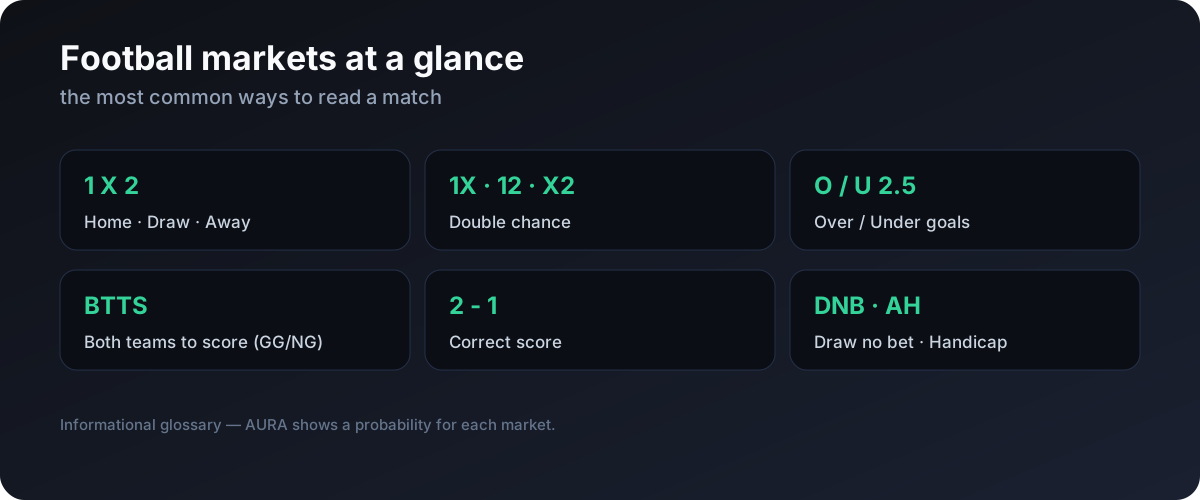
Football Markets & Stats Glossary: 1X2, Over/Under, BTTS, xG and More Explained
Football is full of shorthand. From "1X2" and "BTTS" to "xG" and "draw no bet", the language of markets and match statistics can feel like a foreign dialect. This comprehensive glossary explains every major football market and statistical term in plain English, with clear examples and quick-reference tables — purely for information and understanding, so you can read a fixture page, a stats panel or an AURA prediction with confidence.
Why a Football Markets & Stats Glossary Matters
Modern football coverage blends two languages. One is the language of match data — possession, shots on target, expected goals (xG), team form and head-to-head records. The other is the language of markets — 1X2, double chance, over/under, both teams to score (BTTS), handicaps and correct score. If you follow live scores, read previews or look at an AI model's output, you will meet both vocabularies side by side, often in the same sentence.
This guide is strictly educational. It explains what each term means and how it is read, using simple examples. It is not betting advice and not an invitation to bet. The goal is comprehension: once you know what a term describes, you can interpret a fixture analysis, a stats dashboard or an AURA prediction without guessing. AURA, the AI engine inside SportPicker, produces probabilistic estimates for many of these markets — likelihoods, never certainties — and understanding the vocabulary helps you read those probabilities correctly.
How football odds relate to probability
Many market terms are expressed as odds. Odds are simply a way of writing how likely an outcome is thought to be. Decimal odds of 2.00 imply roughly a 50% chance; odds of 4.00 imply roughly 25%. The quick conversion is: implied probability ≈ 1 ÷ decimal odds, expressed as a percentage. The table below shows the relationship for common decimal odds. Note that real-world odds always sum to slightly more than 100% across all outcomes — that built-in margin is called the overround or 'vig', and it is why the implied probabilities of all results in a market add up to more than 100.
| Decimal odds | Implied probability | Plain-English reading |
|---|---|---|
| 1.20 | ~83% | Strong favourite |
| 1.50 | ~67% | Clear favourite |
| 1.83 | ~55% | Slight favourite |
| 2.00 | ~50% | Even money / coin-flip |
| 2.50 | ~40% | Mild underdog |
| 3.50 | ~29% | Underdog |
| 5.00 | ~20% | Long shot |
| 10.00 | ~10% | Outsider |
Odds and probabilities throughout this guide are illustrative and for information only. They describe likelihoods, not outcomes. No model, including AURA, can guarantee a result — football is inherently uncertain, which is precisely what makes it worth watching.
Core Match Result Markets
These are the foundational markets built around the final result of a 90-minute match (plus stoppage time, but excluding extra time and penalties unless stated). They are the first terms most people encounter.
1X2 (match result / full-time result)
The 1X2 market covers the three possible outcomes of a match. '1' means the home team wins, 'X' means the draw, and '2' means the away team wins. It is the single most common way to express a football result. When a preview says a fixture is '1 at 1.80, X at 3.60, 2 at 4.50', it is listing the home win, draw and away win in that order. Because there are exactly three outcomes, 1X2 is sometimes called the three-way market.
Example: Manchester at home to a mid-table side might show 1 = 1.70, X = 3.80, 2 = 4.80. The low number on '1' reflects the home team being favoured. AURA might estimate something like a 58% home win, 24% draw, 18% away win — note these are probabilities, summing to 100%, rather than odds.
Double chance
Double chance combines two of the three 1X2 outcomes into a single line, so it covers two results at once. There are three variants: '1X' (home win or draw), 'X2' (draw or away win) and '12' (home win or away win, i.e. anything but a draw). Because it covers two outcomes, double chance is more likely to come up than a single 1X2 selection, which is reflected in lower odds.
Example: if you read 'X2 covers the draw and the away win', it means the only result that would not satisfy that line is a home win. Double chance is often discussed when one team is seen as solid but not dominant.
Draw no bet (DNB)
Draw no bet removes the draw from the equation entirely. There are only two selections — home or away — and if the match ends level, the line is treated as void (the stake is returned, in betting terms). It effectively turns a three-way market into a two-way one by neutralising the draw. Analysts mention DNB when they want to express a lean towards one team without the risk of the draw counting against it.
Half-time / full-time (HT/FT)
This market asks for the result at both half-time and full-time, in sequence. A selection like 'Home/Home' means the home team leads at the break and also wins at the end. 'Draw/Home' means level at half-time, home win at full-time — a common pattern when a team breaks the deadlock after the interval. There are nine possible combinations, which makes it one of the harder markets to call and explains the longer odds attached to most of them.
| HT/FT code | Half-time leader | Full-time result |
|---|---|---|
| Home/Home | Home ahead | Home win |
| Home/Draw | Home ahead | Draw |
| Home/Away | Home ahead | Away win |
| Draw/Home | Level | Home win |
| Draw/Draw | Level | Draw |
| Draw/Away | Level | Away win |
| Away/Home | Away ahead | Home win |
| Away/Draw | Away ahead | Draw |
| Away/Away | Away ahead | Away win |
Goals-Based Markets
This family of markets ignores who wins and focuses on how many goals are scored, and by whom. They are popular because they can be followed regardless of which team you favour, and they connect closely to attacking and defensive statistics like xG.
Over/Under (e.g. Over/Under 2.5 goals)
Over/Under sets a line for the total number of goals in a match and asks whether the actual total will be above ('over') or below ('under') it. The most common line is 2.5 goals. 'Over 2.5' means three or more goals in total (e.g. 2-1, 3-0, 2-2); 'Under 2.5' means two or fewer (e.g. 1-0, 1-1, 0-0). The half-goal (.5) is used deliberately so there can never be an exact tie on the line.
Lines can be set anywhere — 1.5, 2.5, 3.5 and so on. A fixture between two attacking teams might be framed around 'Over 3.5', while a tight defensive contest could centre on 'Under 2.5'. Over/Under markets also exist for other countables, such as total corners or total cards, using the same principle.
Both teams to score (BTTS)
Both teams to score, abbreviated BTTS and sometimes labelled 'GG/NG' (goal-goal / no-goal), asks a simple yes/no question: will both teams find the net? 'BTTS Yes' is satisfied by any scoreline where each side scores at least once (1-1, 2-1, 3-2). 'BTTS No' covers any match where at least one team fails to score (1-0, 0-0, 3-0). It is independent of the result — a 1-1 draw and a 3-2 home win both settle 'BTTS Yes'.
Correct score
Correct score asks for the exact final scoreline — 2-1, 0-0, 3-2 and so on. It is the most precise goals market and, because there are so many possible scorelines, individual selections carry long odds. Previews often highlight the two or three 'most likely' correct scores rather than a single prediction. AURA's exact-score output is a probabilistic estimate: it ranks plausible scorelines by likelihood, it does not promise one.
Odd/Even and team totals
Two simpler goals markets round out the family. Odd/Even asks whether the total number of goals will be an odd or even number (0 counts as even). Team totals apply the over/under idea to a single side — for example, 'home team Over 1.5 goals' asks whether the home side alone scores two or more, regardless of what the opponents do.
Handicap Markets
Handicaps level the playing field by giving one team a virtual head start or deficit in goals. They are useful when one side is much stronger, because a straight win for a heavy favourite carries little uncertainty. There are two main families — European and Asian — and they behave differently.
European handicap
A European (or three-way) handicap applies a whole-goal adjustment and keeps the draw as a possible outcome. If the away team is given a +1 handicap (written 0:1), one goal is added to their final score for settlement purposes. So if the match finishes 2-1 to the home side, the handicap result is 2-2 — a 'handicap draw'. Because the draw remains in play, a European handicap still has three outcomes, just like 1X2.
Asian handicap
An Asian handicap removes the draw and often uses quarter-goal lines (such as -0.25, -0.75, -1.25) to split a stake across two adjacent handicaps. A favourite at -1.5 must win by two or more clear goals for that line to come in; a -0.5 line is effectively the same as a straight win, since any winning margin clears half a goal. Quarter lines like -0.75 mean half your notional stake sits on -0.5 and half on -1.0, which is why Asian handicaps can produce 'half-win' or 'half-loss' settlements. The key appeal is that they reduce three outcomes to effectively two.
| Handicap line | What the favourite needs | Example result |
|---|---|---|
| -0.5 | Win by any margin | 1-0 clears it |
| -1.0 | Win by 2+; win by exactly 1 = stake void | 2-0 wins, 1-0 void |
| -1.5 | Win by 2 or more clear goals | 2-0 clears it, 1-0 does not |
| -0.75 | Win by 2 = full, win by 1 = half | 2-0 full, 1-0 half |
| +0.5 (underdog) | Draw or win | 1-1 clears it |
Reading Match Statistics
Markets describe outcomes; statistics describe performance. The metrics below are what analysts and AI models use to understand how a match unfolded — or how a future one might. They appear on most modern match pages and feed directly into AURA's reasoning.
Expected goals (xG)
Expected goals, or xG, is the headline advanced metric in football. It assigns every shot a value between 0 and 1 representing the probability that an average attempt from that position and situation would result in a goal. A tap-in from inside the six-yard box might be worth 0.7 xG; a speculative effort from 30 yards might be 0.03 xG. Add up a team's shots and you get their total xG for the match — a measure of chance quality, not just chance quantity.
Example: a side that wins 1-0 but records 0.4 xG against 2.1 xG was arguably fortunate, having created less than its opponent. Over many matches, xG helps separate teams that are genuinely creating good chances from those riding a hot streak of finishing. It is a descriptive tool, not a crystal ball — a low-xG team can still win on the day.
Possession
Possession is the percentage of time (or passes) a team controls the ball, with the two sides always summing to 100%. A 65%–35% split means one team had the ball roughly two-thirds of the time. High possession does not guarantee chances or goals — some teams deliberately concede possession and counter-attack — but it is a useful indicator of which side is dictating the rhythm of a game.
Clean sheet
A clean sheet means a team did not concede any goals in a match — its defence and goalkeeper kept the opposition off the scoresheet. 'Home clean sheet' is satisfied by any result where the away side fails to score (1-0, 2-0, 0-0). It is closely linked to BTTS: if either team keeps a clean sheet, then 'BTTS No' is automatically true.
Team form and head-to-head
Team form summarises a side's recent results, usually shown as a string of letters for the last five or six matches — for example, 'W W D L W' (win, win, draw, loss, win). It gives a quick sense of momentum, though it does not account for the strength of the opponents faced. Head-to-head (H2H) is the historical record between two specific teams: how their previous meetings have gone. Both are context, not prediction — recent form and past meetings inform expectations but never dictate the next result.
xG
Quality of chances created, summed per team. Shows whether a result was deserved or fortunate over time.
Possession
Share of ball control, summing to 100% across both sides. High possession dictates tempo but doesn't guarantee goals.
Clean sheet
No goals conceded. If either team keeps one, 'BTTS No' is automatically true for that match.
Form & H2H
Recent results string and historical meetings between two teams. Useful context, never a guarantee.
Quick-Reference Summary of the Main Markets
The table below condenses the headline markets into one-line meanings with a short example, so you can scan and recall them at a glance. Use it as a cheat sheet when reading a fixture page or an AURA prediction panel.
| Market | One-line meaning | Quick example |
|---|---|---|
| 1X2 | Home win (1), draw (X) or away win (2) | '1' = home team wins |
| Double chance | Covers two of the three 1X2 outcomes | '1X' = home win or draw |
| Draw no bet | Two-way; draw voids the line | Home or away, level = void |
| HT/FT | Result at half-time and full-time | 'Draw/Home' = level then home win |
| Over/Under 2.5 | Total goals above or below 2.5 | 'Over 2.5' = 3+ goals |
| BTTS | Do both teams score? Yes/No | 'Yes' = each side scores 1+ |
| Correct score | The exact final scoreline | '2-1' |
| Odd/Even | Is the total goal count odd or even? | 0-0 = even |
| European handicap | Whole-goal head start, draw stays | Away 0:1, 2-1 = handicap draw |
| Asian handicap | Goal head start, no draw, quarter lines | Favourite -1.5 must win by 2+ |
| Clean sheet | A team concedes zero goals | 'Home clean sheet' = away scores 0 |
A simple reading order for any fixture
- Start with the result picture: what does 1X2 suggest, and how strong is the favourite?
- Check the goals expectation: is the match framed around Over or Under, and what about BTTS?
- Look at the underlying stats: xG, form and head-to-head for context on how the teams arrive.
- If one side is heavily favoured, see how handicap lines reframe the contest.
- Treat any AURA probability as a likelihood — one possible reading of the data, not a fixed outcome.
Common Abbreviations You'll See
Football coverage leans heavily on abbreviations, especially on compact match pages and mobile screens. Here are the ones you will meet most often, gathered in one place.
- 1X2 — match result (home / draw / away)
- DC — double chance
- DNB — draw no bet
- HT/FT — half-time / full-time result
- O/U — over/under (total goals)
- BTTS or GG/NG — both teams to score (goal-goal / no-goal)
- CS — correct score (or, in defensive context, clean sheet)
- AH / EH — Asian handicap / European handicap
- xG — expected goals
- H2H — head-to-head record
- FT — full time; HT — half time
When a term could mean two things — 'CS' for correct score versus clean sheet, for instance — let the surrounding context decide. A goals or scoreline section means correct score; a defensive or BTTS section means clean sheet.
How AURA Uses These Terms
AURA is the AI engine inside SportPicker. It reads the same statistical inputs described above — xG, form, head-to-head, and more — and produces probabilistic estimates across many of the markets in this glossary: 1X2, over/under, BTTS, double chance and a ranked set of likely correct scores. Crucially, every figure it produces is a probability, expressed as a percentage or a confidence level, never a promise.
That distinction matters when you read the output. If AURA estimates a 60% chance of 'Over 2.5 goals', that is its reading of how likely a high-scoring game is — it explicitly allows for the 40% of cases where it does not happen. The terms in this guide are the building blocks of that output, which is provided for information and entertainment. Football's unpredictability is a feature, not a flaw, and no statistical model removes it.
Putting it together: a worked reading
Imagine a match page showing 1 = 1.75 (home favourite), Over 2.5 leaning likely, BTTS Yes leaning likely, home xG trending higher than away xG over recent games, and home form of 'W W D W L'. Read holistically, that paints a picture of a strong home side expected to score in an open game — but the presence of 'BTTS Yes' as a probability signals the away team is also expected to find the net, so a comfortable clean-sheet win is less likely than the raw 1X2 favourite status alone might suggest. That is the value of knowing the vocabulary: each term adds a layer of nuance.
What does 'Over/Under 2.5' actually mean?
It refers to the total number of goals scored by both teams combined. 'Over 2.5' means three or more goals (such as 2-1 or 3-0), while 'Under 2.5' means two or fewer (such as 1-0 or 1-1). The half-goal is used so the total can never land exactly on the line.
What is the difference between BTTS and a clean sheet?
BTTS (both teams to score) asks whether each side scores at least once. A clean sheet means one specific team conceded no goals. They are linked: if either team keeps a clean sheet, then 'BTTS No' is automatically true, because at least one side failed to score.
What does xG (expected goals) tell me that the scoreline doesn't?
xG measures the quality of the chances a team created, not just whether they went in. A team can win 1-0 with low xG (riding luck) or lose 0-1 with high xG (wasteful finishing). Over many matches, xG helps reveal which teams are genuinely creating good opportunities rather than relying on hot or cold streaks.
How is an Asian handicap different from a European handicap?
A European handicap applies a whole-goal head start and keeps the draw as a possible outcome, so it has three results like 1X2. An Asian handicap removes the draw and often uses quarter-goal lines, which can split a settlement into half-win or half-loss. The Asian version effectively reduces the contest to two outcomes.
Do the implied probabilities in odds add up to 100%?
Not in practice. While a fair model's probabilities for all outcomes of a market sum to exactly 100%, published odds always imply a total slightly above 100%. That extra is the built-in margin known as the overround. It is why you cannot simply convert published odds into true probabilities without accounting for it.
Are AURA's predictions guaranteed?
No. AURA produces probabilistic estimates for information and entertainment only — likelihoods, not certainties. A 70% probability still leaves a 30% chance the outcome does not occur. Football is inherently unpredictable, and no model can remove that uncertainty.