

AURA Explained: Inside the AI Engine That Powers Free Football Predictions
AURA is the AI engine behind every SportPicker football prediction. This pillar guide opens up the whole pipeline: the structured, fixture-specific data it analyses, the two-stage way it converts that data into calibrated probabilities, the curated set of markets it outputs, and how its real-world performance is published — wins and losses alike — on a live, inspectable track-record page. It also explains, plainly, how to treat predictions as information and entertainment rather than instructions, because AURA is probabilistic by design and football never stops surprising us.
What AURA Actually Is: The AI Engine Behind SportPicker Predictions
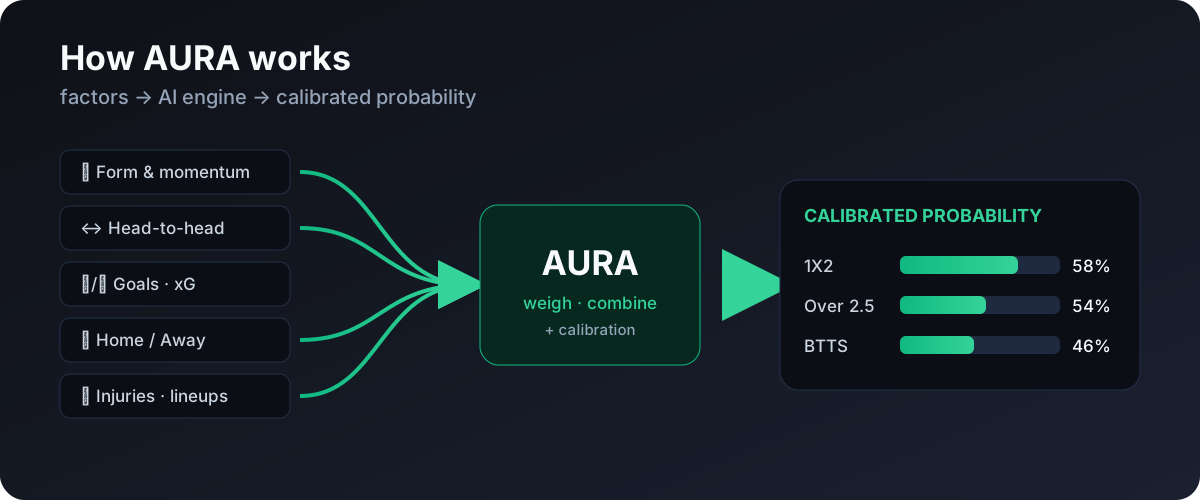
AURA is the artificial-intelligence engine that powers every football prediction you see across SportPicker. When you open a match page and read a concise analysis, a calibrated confidence figure and a short list of suggested markets, that output is the visible tip of a much larger process. AURA is not a tipster, a person, or a crystal ball. It is a structured analytical pipeline that gathers a wide spread of objective football data, reasons over it, and expresses its conclusions as probabilities. Understanding how that pipeline works is the single best way to use AURA well, because once you can see how a probability is built, you can also see exactly what it is and is not telling you.
This guide is a complete, transparent walkthrough of the AURA AI engine: the data it ingests, how it turns that data into probabilities, the football markets it outputs, the way its real-world performance is published on the accuracy track-record page, and how to treat predictions as information and entertainment rather than instructions. Throughout, one principle holds: AURA is probabilistic. It deals in likelihoods, not certainties, and football is a sport that delights in defying both. SportPicker is a free app for live scores, statistics and AI predictions, and AURA exists to make football more interesting to follow, not to tell anyone what to do with their money.
Probabilistic, Not Prophetic
The most important mental model for AURA is this: a prediction with a high confidence figure is a statement about the long run, not a promise about a single Saturday afternoon. If AURA assigns a market a confidence of, say, the high end of its range, it is saying that across many similar situations, that outcome tends to occur often. It is not saying the result is settled in advance. A favourite can lose. A defensively solid side can ship three goals. A reliable scoring pattern can dry up for ninety minutes. That inherent uncertainty is a feature of football, not a flaw in the engine, and it is why AURA never frames anything as guaranteed.
AURA predictions are provided strictly for information and entertainment. They are probability estimates about football outcomes, not betting advice, not financial advice, and never a guarantee. Any odds shown are educational context that illustrates how the market prices an event. Past performance does not guarantee future results.
The Data AURA Analyses
A prediction is only as good as the evidence behind it, so AURA begins every analysis by assembling a broad, structured snapshot of the fixture from specialised sports-data sources. Rather than leaning on a single number or a hunch, the engine pulls multiple independent layers of information in parallel and combines them. Each layer answers a different question about the match, and together they form the context that the model reasons over.
The Core Data Layers
For any given fixture, AURA gathers and structures the following families of data before it forms a view. Each one is fetched fresh for the specific teams, league and season involved, so the picture reflects the current campaign rather than generic reputation.
| Data layer | What it captures | Why it matters for a prediction |
|---|---|---|
| Team statistics | Season form, home and away splits, goals scored and conceded, averages, clean sheets, failure-to-score counts, scoring patterns by minute, preferred formations | Establishes the baseline scoring and defensive profile of each side in the contexts that actually apply |
| League standings | Current rank, points, goal difference, recent form string, and any descriptive status such as a relegation or qualification position | Frames the stakes and the gulf (or lack of it) in quality between the two teams |
| Recent fixtures | The last five matches for each team, with results and scorelines | Reveals momentum, streaks and whether headline stats are rising or fading |
| Injuries and absences | Reported injuries and unavailable players for the specific fixture | Adjusts expectations when key attackers or defenders are missing |
| Market odds | Prices across a curated set of football markets from a sports-data feed | Acts as a market consensus benchmark to test each pick for value |
| Internal statistical model | An independent statistical forecast, including win probabilities, expected goals and team-strength comparisons | Provides a second, non-language model opinion that AURA weighs against its own reading |
| League top scorers | The leading scorers from the two teams involved | Flags the individual threats most likely to influence the scoreline |
It is worth being explicit about provenance: the underlying numbers come from specialised sports-data providers, and SportPicker does not publicly name them in its product copy. What matters for you as a reader is that the inputs are objective, current and fixture-specific, not anecdotal.
The Data-Quality Gate
Not every fixture in world football is equally well documented. Lower divisions, obscure cup ties and newly promoted sides sometimes arrive with thin data. AURA handles this with an explicit quality gate rather than papering over the gaps. Before a prediction is generated, the engine scores how many of its core layers actually returned usable data. If too few are present, it refuses to produce a prediction at all rather than dress up guesswork as analysis. This is a deliberate honesty mechanism: a sparse, low-confidence forecast helps nobody, so AURA would rather show nothing than show noise.
How AURA Turns Data Into Probabilities
Collecting data is the easy part. The distinctive work is converting a large, messy context into a small set of calibrated probabilities that a human can act on intuitively. AURA does this in stages, and crucially it does not simply trust whatever number the language model first produces. There is a second, evidence-based calibration step layered on top, designed specifically to keep confidence figures honest.
Stage One: Structured Reasoning Over the Context
The assembled data is compiled into a detailed, structured brief and passed to an advanced AI model acting as the reasoning layer. The model is instructed to behave like an experienced football analyst hunting for value rather than for headlines. Its job is to read every layer of evidence, weigh form against fixtures, attack against defence, momentum against the standings, and produce a concise written analysis, a handful of key factors and a shortlist of candidate markets. The instructions deliberately push the model away from lazy, round confidence numbers and towards specific, varied probability estimates, with a built-in discount applied to leagues that history shows are harder to predict.
Stage Two: Value, Not Just Likelihood
AURA is explicitly value-oriented. A pick is treated as interesting only when the engine's estimated probability is higher than the probability implied by the market odds. The implied probability of any price is simply one divided by the odds, expressed as a percentage, so odds of 2.00 imply a fifty per cent chance. By comparing its own estimate against that implied figure, AURA distinguishes between an outcome that is merely likely and one that is interestingly priced. This is the same discipline a serious analyst uses, and it is why the engine sometimes highlights a market that is not the single most probable outcome on the board.
Stage Three: Empirical Calibration
This is the step that separates AURA from a naive model that simply repeats whatever confidence it dreamed up. Every candidate market's confidence is recalibrated by blending the model's self-reported estimate with an empirical historical hit-rate for that type of pick, in that kind of league. The empirical component carries the majority of the weight, precisely because real resolved results are more trustworthy than a model's own optimism. Leagues are bucketed by how predictable they have proven to be, and certain market types are nudged up or down based on how reliably they have actually converted. The final figure is then capped to avoid the false precision of claiming near-certainty. The result is a confidence number that reflects observed reality, not branding.
When you see a confidence figure on AURA, read it as a calibrated, evidence-weighted probability that has been pulled towards what has actually happened in similar past fixtures. It is intentionally not a marketing number, which is why you will rarely see suspiciously round or repetitive values.
The Markets AURA Outputs
AURA does not output every conceivable football market. It deliberately focuses on markets that are statistically tractable and tends to avoid the ones that are mostly noise. Two categories are excluded from its tracked recommendations on principle: the straight match winner, or 1X2, and the exact correct score. The first is too coarse and volatile to track meaningfully as a value pick, and the second is so high-variance that any single outcome is, by definition, unlikely. Instead, AURA concentrates on a curated set of markets where data-driven analysis has more genuine traction.
The Markets In Scope
- Double Chance — covering two of the three possible match results, a more conservative read of which side avoids defeat
- Over/Under goals — with a deliberate preference for the safer thresholds such as Over 1.5, Under 3.5 and Under 4.5 over the more volatile Over 2.5 or Under 2.5
- Both Teams To Score (BTTS) — whether both sides find the net, expressed as Goal or NoGoal
- Multi-goal ranges — bands such as one-to-three or two-to-three total goals, which smooth out the all-or-nothing nature of exact scores
- First Half Winner — which side, if any, leads at the interval
For each fixture AURA assembles several candidate picks across different markets and always tries to include at least one conservative, lower-odds option as an anchor. From that shortlist, a single primary pick is selected for tracking. The selection logic favours the option with the strongest blended hit-rate, breaking ties towards the more predictable, higher-implied-probability choice. Picks with no meaningful value, where the price is too short to be interesting, are filtered out before tracking. This is how AURA decides which one recommendation becomes its accountable, on-the-record call for that match.
How To Read a Confidence Band
Confidence figures are grouped into bands so that you can interpret them at a glance rather than fixating on a single percentage point. The bands are intentionally broad, because the meaningful difference is between a strong lean and a marginal one, not between two adjacent numbers.
| Confidence band | Rough interpretation | Sensible reading |
|---|---|---|
| High | The evidence strongly and consistently supports the pick | A solid lean — still not a certainty, and still subject to football's variance |
| Medium | The data favours the pick but with meaningful counter-arguments | A reasonable view among several plausible outcomes |
| Low | The fixture is genuinely close or poorly documented | Treat as a coin-flip-adjacent talking point rather than a strong signal |
Transparency and the Track-Record Page
Any engine can publish predictions. The harder, more honest thing is to publish what happened next, including the misses. SportPicker does this on its dedicated accuracy and track-record page, where AURA's primary tracked pick for each settled match is recorded against the real result. The page exists so that the engine's claims are accountable and inspectable rather than asserted. This is the heart of SportPicker's experience, expertise, authoritativeness and trust posture: the track record is shown, not merely promised.
What the Accuracy Page Publishes
Rather than quoting any headline figure here, what matters is the structure of what is disclosed, because the structure is what makes it verifiable. The page surfaces several complementary views, each answering a different question a sceptical reader might ask.
- An overall view showing the total number of tracked predictions and how many were resolved correctly, so the sample size is always visible alongside the rate
- A monthly trend, so you can see whether performance is steady, improving or dipping over time rather than relying on a single snapshot
- A breakdown by confidence band, which lets you check whether high-confidence picks actually land more often than low-confidence ones — the real test of whether the calibration is working
- A recent-predictions table listing individual fixtures with the predicted market, the actual result, the confidence shown at the time, and a clear correct-or-incorrect verdict on each
Two design choices make this genuinely transparent rather than cosmetic. First, only predictions that were actually generated before the match and then resolved against the final result are counted — there is no retrospective cherry-picking. Second, the wins and the losses sit side by side in the same table. An engine that only showed its successes would be marketing; an engine that shows every settled call, hit or miss, is being accountable.
Sample Size Shown
Every rate is presented next to the number of predictions behind it, so you can judge whether a figure rests on many matches or just a handful.
Tracked Over Time
A monthly trend prevents any single good or bad run from defining the picture, and lets you watch the engine's consistency.
Calibration Check
Performance split by confidence band lets you verify that higher confidence really does correspond to a higher hit-rate.
Match-by-Match
A recent-results table names individual fixtures with their verdict, so the record is inspectable rather than abstract.
Why No Accuracy Figure Appears In This Guide
You will notice that nowhere in this article is a specific accuracy percentage stated. That is deliberate and principled. A static number written into a guide would be out of date the moment the next round of fixtures resolves, and a fixed claim risks reading like a promise. The honest place for any performance figure is the live track-record page, where it updates as new matches settle and where it is always shown with its sample size and its context. If you want to know how AURA is performing, the answer is not a sentence you read once — it is a page you can check whenever you like, which is exactly how a trustworthy track record should work.
Using Predictions Responsibly
AURA is built to make following football richer and more analytical. It surfaces patterns you might not have spotted, frames a fixture in numbers rather than vibes, and gives you a structured starting point for your own thinking. What it is not is a system that removes uncertainty or that should be followed mechanically. Treating it as the former is the surest way to misunderstand it.
A Healthy Mindset
The best way to use AURA is as one well-informed voice in your own analysis, not as a verdict to be obeyed. Read the written analysis and the key factors, not just the confidence number, because the reasoning tells you why the engine leans the way it does and where it might be wrong. Pay attention to the confidence band as an expression of uncertainty, and remember that even a strong lean is a probability, not a result. Above all, treat the experience as entertainment and information about a sport you enjoy, which is precisely what it is designed to be.
- Read the analysis and key factors, not only the headline confidence — the reasoning is where the real insight lives
- Treat confidence as a probability and a range, never as a settled outcome
- Use the track-record page to keep the engine honest in your own mind, including by looking at the losses
- Remember that any odds shown are educational context illustrating market pricing, not a prompt to do anything
- Keep perspective: football is gloriously unpredictable, which is the whole reason it is worth following
No prediction engine can guarantee a football result, and AURA never claims to. Avoid treating any single high-confidence pick as a sure thing, and never interpret predictions or odds as betting advice or a profit promise. They are information and entertainment about the game — nothing more.
Frequently Asked Questions
What is AURA?
AURA is the AI engine behind SportPicker's football predictions. It gathers structured, fixture-specific data from specialised sports-data sources, reasons over it like an analyst, and expresses its conclusions as calibrated probabilities across a curated set of markets. It is a probabilistic analytical tool for information and entertainment, not a tipster and not a guarantee.
What data does AURA actually analyse?
For each match it pulls team statistics, league standings, the last five fixtures for both sides, injury and absence reports, market odds, an independent statistical forecast, and the leading scorers from the two teams. These layers are fetched fresh for the specific teams, league and season, and combined before the engine forms any view.
How is the confidence figure calculated?
In two parts. First an advanced AI model reasons over the assembled data and proposes a probability for each candidate market. Then AURA recalibrates that number by blending it with an empirical historical hit-rate for that kind of pick in that kind of league, with the real-results component carrying most of the weight and a cap applied to avoid false certainty. The figure you see reflects what has actually happened in similar fixtures, not a marketing number.
Which markets does AURA cover, and why not match winner or correct score?
It focuses on Double Chance, Over/Under goals, Both Teams To Score, Multi-goal ranges and First Half Winner. It deliberately excludes the straight match winner and exact correct score from its tracked recommendations because those markets are too volatile to track as meaningful value picks — a single correct score, in particular, is inherently unlikely.
Where can I see how accurate AURA really is?
On SportPicker's accuracy and track-record page. It publishes the total number of tracked predictions, how many resolved correctly, a monthly trend, a breakdown by confidence band, and a match-by-match table of recent calls with each verdict shown. Only genuine pre-match predictions resolved against real results are counted, and both wins and losses are displayed.
Should I use AURA predictions as betting advice?
No. AURA predictions are provided strictly for information and entertainment. They are probability estimates about football outcomes, not betting, financial or any other advice, and they carry no guarantee or profit promise. Any odds shown are purely educational context that illustrates how the market prices an event.