

Football Odds Explained: A Complete Educational Guide to Decimal Odds, Implied Probability and Markets
Football odds look intimidating, but they are really just probability written in a different language. This educational guide explains what decimal odds mean, how to convert any odd into an implied probability, why the margin (overround) makes them add up to more than 100%, how they sit alongside AURA's probabilities, and the main markets you will encounter. It is strictly information, never betting advice.
What football odds actually are (and what they are not)
A number that expresses probability, not a tip
When you look at a match on SportPicker, you will often see a set of numbers attached to outcomes such as a home win, a draw or an away win. These numbers are football odds. At their simplest, odds are a compact way of expressing how likely an outcome is judged to be, translated into a format that the wider football industry uses to communicate uncertainty. They are not a recommendation, a prediction you should act on, or a signal that one outcome is the right one. They are simply a representation of probability that has been converted into a single figure.
This guide is strictly educational. It exists to help you read and understand the language of odds the way you might learn to read a league table or a expected-goals chart. Nothing here is betting advice, and nothing here is an invitation to place a bet. SportPicker is a free football platform built around live scores, statistics and AURA, our probabilistic AI engine. We show odds as information so that fans can make sense of a number they will inevitably encounter when they follow the game, not so that anyone is encouraged to wager money.
Three formats, one underlying idea
Across the world, odds appear in three main formats: decimal, fractional and American (also called moneyline). They all describe the same underlying probability, just dressed up differently. Decimal odds, common across Europe and the global online world, are the easiest to reason about and the format we focus on in this guide. Fractional odds are traditional in the United Kingdom and Ireland, and American odds dominate in North America. Because the maths is cleanest with decimals, and because decimals map so neatly onto probability, they are the natural starting point for anyone learning how odds work.
Educational note: Everything in this guide is for information and entertainment only. Odds and probabilities describe uncertainty; they never tell you what will happen. SportPicker does not offer gambling, does not provide betting advice, and does not link to bookmakers. If you choose to gamble elsewhere, treat it as paid entertainment with money you can afford to lose.
Decimal odds explained
How to read a decimal odd
A decimal odd is a single number, usually somewhere between just above 1.0 and the high tens or hundreds. The smaller the number, the more likely the outcome is considered. The larger the number, the less likely it is considered. So an outcome priced at 1.50 is judged far more probable than one priced at 7.00. You can think of the decimal figure as a multiplier that already includes your original stake: a 2.00 outcome represents an even-money situation, where the implied chance is roughly one in two.
The classic worked example helps cement the idea. Imagine a hypothetical £10 figure attached to an outcome priced at 2.50. Multiplying 10 by 2.50 gives 25, which represents the total return including the original 10. The profit portion would be 15. This is purely arithmetic to illustrate how the number behaves; it is not a suggestion to stake anything. The key takeaway is that the decimal number is a return multiplier, and that same multiplier is mathematically tied to a probability.
Why decimals are the clearest format for learning
Decimals win on clarity for two reasons. First, comparing two outcomes is trivial: 1.80 is shorter odds than 2.40, full stop, with no mental arithmetic needed. Second, and more importantly for this guide, converting a decimal odd into an implied probability takes a single division. That direct line between a price and a percentage is what makes decimals the ideal teaching format and the reason most analytical football content, including the way AURA surfaces probabilities, leans on them.
- Decimal odds below 2.00 imply an outcome judged more likely than not (over 50%).
- Decimal odds of exactly 2.00 represent an even, 50/50-style situation before any margin is applied.
- Decimal odds above 2.00 imply an outcome judged less likely than not (under 50%).
- The very lowest decimals (for example 1.10 or 1.05) cluster around heavy favourites, while large decimals (10.00 and up) sit with long shots.
- Odds are dynamic: they move as team news, form, injuries and demand shift, so the same fixture can show different numbers at different times.
Converting odds to implied probability
The one formula you need
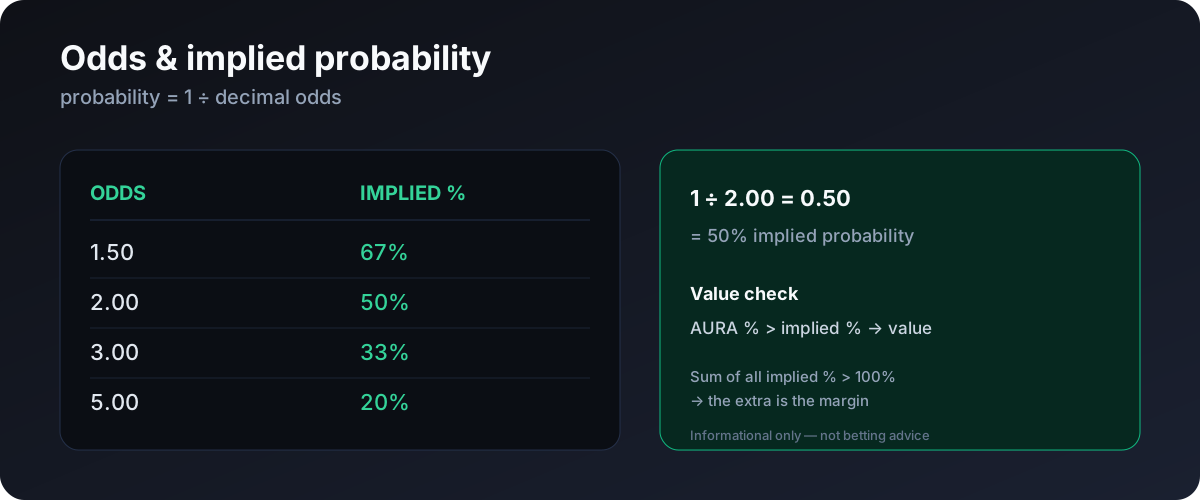
The conversion from a decimal odd to an implied probability is delightfully simple. Divide 1 by the decimal odd, then multiply by 100 to get a percentage. In other words: implied probability (%) = (1 / decimal odd) × 100. An outcome priced at 4.00 therefore implies a probability of 1 / 4.00 = 0.25, or 25%. An outcome at 1.25 implies 1 / 1.25 = 0.80, or 80%. This single calculation is the bridge between the odds you see and the probabilities that analytical engines like AURA work in. Learning it means you can decode any decimal price you encounter.
The word implied matters. The probability you derive this way is the probability implied by that specific price, including whatever margin has been baked into it (more on that shortly). It is not a neutral, true probability of the world. It is the figure that the price is mathematically equivalent to. Understanding that distinction is the single most useful insight in this entire guide, because it stops you treating a market number as objective truth.
A reference table: decimal odds to implied probability
The table below maps a range of common decimal odds to their implied probabilities, rounded to one decimal place. Use it to build intuition: notice how quickly probability falls as odds lengthen, and how the relationship is not linear. Moving from 1.50 to 2.00 changes the implied chance far more than moving from 9.00 to 11.00 does.
| Decimal odds | Implied probability | Plain-English reading |
|---|---|---|
| 1.10 | 90.9% | Very heavy favourite |
| 1.25 | 80.0% | Strong favourite |
| 1.50 | 66.7% | Clear favourite |
| 1.80 | 55.6% | Moderate favourite |
| 2.00 | 50.0% | Even / coin-flip framing |
| 2.50 | 40.0% | Slight underdog |
| 3.00 | 33.3% | Underdog |
| 4.00 | 25.0% | Clear underdog |
| 5.00 | 20.0% | Long shot |
| 7.00 | 14.3% | Big long shot |
| 11.00 | 9.1% | Outsider |
| 21.00 | 4.8% | Rank outsider |
Quick mental shortcut: an outcome at exactly 2.00 is the 50% line. Anything shorter than 2.00 is judged more likely than not; anything longer is judged less likely than not. That single reference point lets you eyeball almost any price at a glance.
Margin and overround: why probabilities add up to more than 100%
The maths that surprises most fans
Here is a fact that catches many people off guard. If you take the three outcomes of a football match (home, draw, away), convert each price into an implied probability, and add them together, the total will almost always be more than 100%. In a fair world with no built-in cushion, the three probabilities would sum to exactly 100%, because one of those three things must happen. The amount by which the real total exceeds 100% is called the overround, the margin, or the vig (short for vigorish). It is the structural reason the long-term economics of betting favour the operator rather than the customer.
A concrete illustration makes this vivid. Suppose a match shows the home win at 2.10, the draw at 3.40 and the away win at 3.60. Converting each gives roughly 47.6%, 29.4% and 27.8%. Add them up and you get about 104.8%. That extra 4.8 percentage points is the overround. It means the displayed prices are shorter (less generous) than the underlying probabilities would justify if no margin existed. The probabilities have been deliberately inflated, which pulls the prices down.
| Outcome | Decimal odds | Raw implied probability | Margin-adjusted (fair) estimate |
|---|---|---|---|
| Home win | 2.10 | 47.6% | 45.4% |
| Draw | 3.40 | 29.4% | 28.1% |
| Away win | 3.60 | 27.8% | 26.5% |
| Total | — | 104.8% | 100.0% |
Removing the margin to see fairer probabilities
Because the raw implied probabilities are inflated, analysts often normalise them to estimate a fairer probability for each outcome. The simplest approach divides each raw probability by the total (in this case 104.8%) so the set sums back to 100%. The right-hand column of the table above shows that adjustment. This normalised figure is closer to the probability the price implies once the cushion is stripped out, although it is still only an estimate and still reflects the assumptions of whoever set the price. It is a useful exercise precisely because it reveals how much of a displayed number is structural margin rather than genuine assessment of the football.
- A lower overround means the displayed prices are closer to the underlying probabilities; a higher overround means a larger built-in cushion.
- Overround is why, over the long run, the sums involved in betting tilt against the customer regardless of skill.
- Markets with more possible outcomes (such as correct score or first goalscorer) typically carry a much larger combined margin than simple two- or three-way markets.
- Normalising probabilities to 100% gives a fairer comparison but never removes the underlying uncertainty of the match itself.
How odds relate to AURA probabilities
Two independent views of the same uncertainty
AURA is SportPicker's probabilistic AI engine. For a given fixture it produces probability estimates for outcomes, expressed directly as percentages rather than as odds. This is a genuinely useful framing because it lets you compare two independent perspectives on the same uncertain event: the probability implied by a market price, and the probability estimated by AURA from data such as form, schedule, squad availability and historical patterns. Neither is a crystal ball. Both are estimates of an inherently unpredictable game, and football's capacity to defy expectation is precisely what makes it worth watching.
Because both views are probabilities, you can lay them side by side on the same scale. If a market price implies 40% for an outcome and AURA estimates something in a similar range, the two perspectives broadly agree. If they diverge, that divergence is interesting information about how differently the two methods are reading the match. It is context, not a directive. AURA output is probabilistic and provided for information and entertainment; it does not tell you what will happen and it should never be treated as a guarantee or a profit promise of any kind.
Why AURA expresses things as probabilities, not odds
Expressing estimates as clean percentages is a deliberate choice. Percentages are honest about uncertainty: a 62% estimate openly says that the other 38% of outcomes remain entirely plausible. Odds, by contrast, blur that honesty because they fold in a margin and present a single price that looks more definitive than it is. By keeping AURA in probability space, SportPicker keeps the focus on understanding the match rather than on a number engineered for a commercial transaction. It also makes the educational link in this guide explicit: once you can convert any odd into an implied probability, you can speak the same language as AURA and reason about both together.
Implied probability
Derived from a price by dividing 1 by the decimal odd. Includes the margin, so it is inflated relative to a fair estimate.
AURA probability
Estimated directly by SportPicker's AI engine from football data and expressed as a clean percentage. Probabilistic, never a guarantee.
Comparing the two
Place them on the same percentage scale to see where the market and AURA agree or differ. Useful context, never a recommendation.
Shared honesty
Both are estimates of an uncertain event. Football routinely surprises both methods, which is exactly why no number is ever certain.
The main football betting markets, explained
From simple three-way bets to specials
Although this guide does not encourage betting, it helps to know the vocabulary, because these market names appear throughout football coverage and analysis. Markets simply describe which question the odds are answering. The most familiar is the match result, often labelled 1X2: the 1 is the home win, the X is the draw, and the 2 is the away win. From there, markets fan out to cover goals, both teams scoring, handicaps and a long tail of specials. Each market carries its own margin, and as a rule the more exotic the market, the larger the built-in cushion tends to be.
The table below summarises the markets you are most likely to encounter, with a plain description of what each one asks. Reading it as a glossary is the right approach: the goal is comprehension of the language, not participation. Understanding that a market with many possible results (like correct score) carries a far bigger combined margin than a binary market (like over/under) is genuinely useful analytical knowledge in its own right.
| Market | What it asks | Typical number of outcomes |
|---|---|---|
| Match result (1X2) | Home win, draw or away win at full time | 3 |
| Double chance | Covers two of the three 1X2 results at once | 3 |
| Over/Under goals | Whether total goals are above or below a line (e.g. 2.5) | 2 |
| Both teams to score (BTTS) | Whether both sides score at least one goal | 2 |
| Asian handicap | Result after a virtual head start/deficit is applied | 2 |
| Correct score | The exact final scoreline | Many |
| First/anytime goalscorer | Which player scores first or at all | Many |
| Half-time/full-time | The result at the break and at the final whistle | 9 |
Why some markets carry more margin than others
The spread of possible outcomes drives the margin. A two-way market like both teams to score has just two answers, so the margin sits on top of a simple split. A correct-score market might have dozens of plausible results, and the combined overround across all of them is typically much larger. This is why analytical fans tend to find the simpler markets easier to interpret: the relationship between the price and the implied probability is cleaner, and there is less structural margin obscuring the underlying assessment of the match. None of this changes the core message that these are tools for understanding, not for action.
- Identify which question the market is answering (result, goals, both teams scoring, and so on).
- Convert each displayed decimal odd into an implied probability using 1 divided by the odd.
- Add the implied probabilities for that market together to reveal the overround above 100%.
- Optionally normalise back to 100% to estimate a fairer probability for each outcome.
- Compare the fairer estimate against AURA's probability for context, remembering both are estimates.
Responsible framing and how to use odds wisely
Odds are information, not instruction
The healthiest way to relate to odds is to treat them exactly as you would treat any other football statistic: as a data point that adds context. A price tells you how the market collectively reads a match, much as an expected-goals figure tells you something about chance quality. It does not tell you what to do, it does not predict the future, and it carries no obligation. SportPicker presents odds and AURA probabilities so that curious fans can understand the game more deeply, follow the narrative of a fixture, and enjoy the analytical side of football. That is the entire purpose.
It is worth repeating the structural truth from earlier: the overround means that, across many events and over the long run, the economics of betting favour the operator. No system, model, tip or pattern changes that underlying mathematics. Any source promising guaranteed wins, sure things, a hundred per cent record or a foolproof method is making a claim that the structure of odds makes impossible. AURA's probabilities are estimates of uncertain events and are offered for information and entertainment only, never as a profit promise and never as a guarantee.
If gambling ever stops feeling like entertainment, support is available. In the UK you can contact GamCare on 0808 8020 133 or the National Gambling Helpline, both free and confidential. Other countries have their own helplines. Only ever gamble with money you can afford to lose, set firm limits in advance, and never chase losses. SportPicker provides information and statistics, not betting advice.
A simple, responsible checklist for reading odds
If you keep a few principles in mind, odds become a useful lens for understanding football rather than a source of pressure. The list below distils the responsible mindset this guide has been building toward. It is the kind of framing we apply to every number on SportPicker, including AURA's, and it is the note we want you to leave with.
- Always remember that an implied probability includes a margin and is therefore inflated relative to a fair estimate.
- Treat both odds-implied probabilities and AURA probabilities as estimates of an uncertain event, never as certainties.
- Be sceptical of any claim of guaranteed wins, sure things or perfect records; the maths of overround makes them impossible.
- Use odds and probabilities to understand and enjoy the football, not as instructions to act on.
- If you choose to gamble elsewhere, set limits first, treat any stake as the cost of entertainment, and seek help if it stops being fun.
How do I convert decimal odds to a percentage?
Divide 1 by the decimal odd and multiply by 100. For example, 2.50 becomes 1 / 2.50 = 0.40, which is 40%. The result is the probability implied by that price, including any built-in margin, so it is an inflated rather than a neutral figure.
Why do the probabilities for a match add up to more than 100%?
The amount above 100% is the overround or margin. In a perfectly fair market the three results of a match would sum to exactly 100%, but a cushion is built into the prices, which inflates each implied probability. That margin is the structural reason betting economics favour the operator over the long run.
What is the difference between odds-implied probability and an AURA probability?
An implied probability is derived from a market price and includes the margin, so it is inflated. An AURA probability is estimated directly by SportPicker's AI engine from football data and is expressed as a clean percentage. Both are estimates of an uncertain event, and you can compare them on the same percentage scale for context only.
Which is the easiest odds format to understand?
Decimal odds, because comparing them needs no arithmetic (a lower number is shorter odds) and converting them to a probability takes a single division. Fractional and American formats describe the same underlying probability but require more steps to interpret.
Do shorter odds guarantee an outcome will happen?
No. Short odds simply mean an outcome is judged more likely, for instance 1.25 implies roughly an 80% chance. The remaining 20% is real, and football is full of upsets. No odd, however short, and no probability, however high, ever guarantees anything.
Does SportPicker offer betting or tips?
No. SportPicker is a free football platform for live scores, statistics and AURA probabilities. This guide is purely educational, we do not provide betting advice, and we do not link to bookmakers. Everything is for information and entertainment only.