

Football Stats That Actually Matter: xG, Form, Shots, Possession and More Explained
The final score is the most famous number in football and often the most misleading. This pillar guide unpacks the stats that actually explain a match — xG, form, head-to-head, home and away splits, goals, shots, possession, set pieces and clean sheets — showing you how to read each one without falling for the common traps, and how AURA weighs them all into a probabilistic view of how a game might unfold.
Why football statistics matter when you read a match
For most of football's history, supporters judged teams by the eye test and the final scoreline. A 1-0 win was a win, full stop. But the modern game has shown us that the scoreline is often the least reliable narrator of what actually happened on the pitch. A team can dominate, create a dozen clear chances, hit the post twice and still lose to a deflected shot in stoppage time. Statistics exist to close that gap between what looked like it should have happened and what the numbers say was genuinely likely to happen.
This guide walks through the football stats that matter most for understanding a single match or a run of fixtures: expected goals (xG), recent form, head-to-head records, home and away splits, goals for and against, shots and shots on target, possession, set pieces and clean sheets. For each one we explain what it measures, how to read it sensibly, the traps that catch out casual readers, and how AURA, the predictive engine inside SportPicker, weighs that signal alongside dozens of others. None of this is betting advice. The aim is to make you a sharper, more confident reader of the game.
Think of these metrics as instruments on a dashboard. No single dial tells you everything, and any one of them can mislead in isolation. Read together, with context, they paint a far more honest picture than the result alone. That is the mindset to carry through every section below.
The golden rule: context beats raw numbers
Before we touch a single metric, internalise one principle. A number without context is almost meaningless. Sixty per cent possession against a side parked in a deep defensive block is a very different signal from sixty per cent possession earned by ripping a high press apart. Three goals conceded sounds alarming until you learn they came across three away trips to the division's top three. Every stat in this guide should be read alongside the opponent, the venue, the competition and the situation. AURA is built around exactly this idea: signals are always weighted relative to context, never taken at face value.
A quick mental model: outcomes in football are a mix of underlying performance (process) and luck (variance). Stats like xG try to measure the process. The scoreline mixes process and variance together. The more you separate the two, the better you understand a match — and the less a freak result will fool you.
Expected goals (xG): the single most useful modern metric
What xG actually measures
Expected goals, almost always written as xG, assigns every shot a value between 0 and 1 representing the probability that an average player would score from that exact situation. A tap-in from two yards might be worth 0.85 xG; a speculative effort from 30 yards might be worth 0.03. Add up every chance a team creates in a match and you get their total xG for that game — an estimate of how many goals their chances were worth, regardless of how many actually went in.
The value of each chance is derived from large historical samples of similar shots, accounting for factors such as distance from goal, the angle, the body part used, whether it followed a cross or a through ball, and the type of build-up. The headline appeal is simple: xG strips out a huge amount of the luck baked into a final score and tells you who created the better chances.
How to read xG sensibly
Compare a team's xG to the actual goals they scored. If a side keeps outscoring their xG by a wide margin, they are either enjoying a hot finishing streak (which tends to cool) or they have genuinely elite finishers — and over a long sample, most teams drift back toward their xG. If a team consistently scores fewer than their xG suggests, they are creating good chances but wasting them, which often corrects upward over time. This idea of regression toward the underlying numbers is one of the most powerful concepts in football analysis.
Also look at xG conceded (sometimes xGA, expected goals against). A team might be keeping clean sheets while allowing a flurry of high-quality chances — a sign their goalkeeper is on an unsustainable run or they are riding their luck. The gap between xG and xGA across many matches is a far steadier guide to a team's true quality than league position after a handful of games.
- Single-match xG is noisy — one or two big chances swing it heavily, so never over-read a single game.
- Rolling xG over 6 to 10 matches is far more stable and a better quality indicator.
- xG does not capture the quality of the specific player taking the shot, nor goalkeeper positioning — treat it as a chance-quality estimate, not a verdict.
- A low-xG win is a warning sign, not a cause for celebration; a high-xG loss often means the performance was better than the result.
- Penalties carry a fixed high xG (around 0.76–0.79); strip them out when you want to judge open-play creation.
How AURA uses xG
AURA treats xG and xG conceded as core inputs into its attacking and defensive strength estimates, but it leans on rolling, opponent-adjusted figures rather than raw season totals. A high xG built up against weak opposition is discounted; chances created against organised, in-form defences are weighted more heavily. The engine also watches the gap between actual goals and xG to flag teams likely to regress in either direction. The output is always probabilistic — a distribution of likely outcomes, presented for information and entertainment, never a guarantee.
Recent form: momentum, but read it carefully
What form really tells you
Recent form is the most quoted stat in football punditry and the most frequently misread. The classic WWDLW string of the last five results is a starting point, not an answer. Five wins can hide five narrow, fortunate victories with poor underlying numbers; three draws can mask dominant performances that simply lacked a clinical finish. Form matters because squads carry confidence, fitness, tactical familiarity and injury status from week to week — but the headline run of results is only the surface.
The smarter way to read form is to look underneath the results at the performance level: were the xG numbers strong, were chances being created and limited, was the team controlling matches? A side on a four-game winless run with excellent underlying numbers is often a better bet to turn the corner than a four-game winner riding its luck.
Weighting recency and strength of schedule
Not all recent matches deserve equal weight. The most recent fixture is more informative than one from six weeks ago, and a result against a title contender tells you more than a thrashing of a relegation candidate. Strength of schedule is the silent variable behind most misleading form lines. Always ask who the points were won against, and where.
| Form line (last 5) | Surface read | What to check underneath |
|---|---|---|
| W W W W W | Flying, unstoppable | xG vs goals scored — are wins backed by chance creation or finishing luck? |
| W D W D W | Solid, consistent | Quality of opponents and whether draws were dominant or fortunate |
| L L D L L | In crisis | Fixture difficulty, injuries returning, xG suggesting better days ahead |
| W L W L W | Inconsistent | Home/away split — is the pattern venue-driven rather than random? |
| D D D D D | Stuck, can't win | Are they creating enough? Low xG points to a finishing or quality issue |
AURA models form as a recency-weighted, opponent-adjusted signal rather than a simple count of recent wins. Performance metrics underneath the results carry more weight than the results themselves, which helps the engine spot teams whose form line and true level have drifted apart.
Head-to-head: useful context, rarely a predictor on its own
The seduction of the H2H record
Commentators love a head-to-head stat: "the home side haven't beaten this opponent in seven years." It makes a compelling story, but as a standalone predictor it is among the weakest tools in the box. Squads turn over, managers change, tactical identities are rebuilt, and a result from three seasons ago tells you almost nothing about two teams that have each replaced half their starting eleven since.
Where head-to-head data earns its keep is in stylistic match-ups. Some teams genuinely struggle against a specific shape — a high press that unsettles a possession side, a deep block that frustrates a team reliant on space in behind. When the personnel and approach have been stable across recent meetings, recent H2H results can reveal a tactical pattern worth respecting.
- Weight only the most recent meetings — ideally those involving broadly the same squads and managers.
- Separate home and away H2H; a record at one venue rarely transfers to the reverse fixture.
- Look for stylistic clashes (press vs build-up, block vs counter) rather than raw win counts.
- Discount fixtures from different competitions where rotation or intensity differed wildly.
- Treat a long unbeaten run in the fixture as a soft signal, not a rule — football has no memory.
AURA includes head-to-head as a minor, recency-filtered contextual input. It deliberately avoids over-weighting old meetings, because squad and managerial turnover make distant results poor guides. The engine cares far more about current form and underlying numbers than about who won the same fixture several seasons ago.
Home and away splits: one of football's most reliable edges
Why venue still matters
Home advantage is one of the most durable patterns in all of sport. Across most leagues, home teams win clearly more often than away teams, and the effect shows up in goals scored, shots taken and even refereeing decisions. The drivers are familiar surroundings, crowd support, no travel fatigue and tactical comfort. Some sides are transformed by their own stadium; others travel poorly and shed points on the road regardless of overall quality.
Reading splits means looking at a team's home and away records separately rather than blending them into one season-long number. A mid-table team might be a near-fortress at home and a soft touch away — a profile completely lost if you only glance at the combined table. Goals scored and conceded per game, points per game and xG should all be split by venue when you want an honest read.
| Metric | Home | Away | What the split suggests |
|---|---|---|---|
| Points per game | 2.1 | 0.9 | Strong at home, fragile on the road — a classic split profile |
| Goals scored | 1.9 | 0.8 | Attack dries up away — fewer high-quality chances created |
| Goals conceded | 0.7 | 1.6 | Defensive solidity is venue-dependent |
| xG for | 1.8 | 1.0 | Underlying creation drops sharply away from home |
| Clean sheets | 45% | 15% | Backline far harder to break down at home |
When you see a team's headline season stats, always ask: how much of this is built at home? A side that has played most of its recent matches at home will look stronger than it really is, and that flatters its numbers heading into an away trip.
AURA models home and away strength as separate parameters, then adjusts for the specific venue and the travel involved. A team's away creation, away defensive record and away xG all feed a distinct profile from their home one, so the engine never assumes a home fortress will play the same way on the road.
Goals for and against: the foundation, with caveats
The simplest signal, and its blind spot
Goals scored (goals for) and goals conceded (goals against) are the oldest stats in the book, and they remain the foundation of any attacking and defensive assessment. Goal difference is the tiebreaker in most league tables for good reason: over a full season it correlates strongly with quality. A team that scores a lot and concedes little is, almost by definition, a good team.
The blind spot is variance and timing. Over a short run, goals are lumpy — a 5-0 win and four 0-0 draws produce the same goals-for total as five 1-0 wins, but the underlying story differs completely. Goals are also the end product of a long chain (creating chances, taking them, the keeper not saving them), so they carry more luck than the metrics earlier in that chain, like xG and shots. That is precisely why xG was invented: to estimate goals from chance quality before finishing variance distorts the picture.
- Use goals for and against as the baseline, but always cross-check against xG and xG conceded.
- A big win or heavy loss can skew per-game averages — look at the median performance, not just the mean.
- Separate goals scored in open play from set-piece and penalty goals to understand the source of a team's threat.
- Goals conceded late in matches can signal fitness or game-management issues worth probing.
- Combine goals for and against to read total-goals tendencies (a useful lens for over/under markets, framed purely as information).
AURA uses goals for and against as baseline strength inputs but blends them with xG-based estimates so that a fortunate or unfortunate goal tally does not dominate the picture. The engine effectively asks: are the goals backed by the chances, or are they running ahead of (or behind) the underlying performance?
Shots and shots on target: volume, quality and intent
What shot data reveals before the goals arrive
Shots and shots on target sit one step earlier in the chance-creation chain than goals, which makes them a leading indicator. A team racking up shots and forcing the keeper into repeated saves is generating pressure that often turns into goals over time, even if the current scoreline does not reflect it. Conversely, a team scoring freely on very few shots is likely overperforming and due a correction.
The key refinement is quality over quantity. Twenty shots from distance are worth far less than six shots from inside the six-yard box. This is why shot location and shots on target matter more than total shot count, and why xG — which weights each shot by quality — ultimately supersedes raw shot tallies. Still, the ratio of shots on target to total shots (a rough shooting accuracy measure) and shots conceded inside the box are valuable, accessible signals.
| Metric | What it measures | What a high value can indicate |
|---|---|---|
| Total shots | Volume of attempts | Territorial dominance — but check shot quality before trusting it |
| Shots on target | Attempts forcing a save or goal | Genuine threat and goalkeeper pressure |
| Shots in the box | Attempts from high-value areas | Quality chance creation, strong link to future goals |
| Shots conceded in box | Opponent attempts from danger zones | Defensive fragility, even if goals haven't followed yet |
| Shot conversion % | Goals per shot | Finishing efficiency — extreme values tend to regress |
AURA reads shot volume and shot location as supporting evidence for its xG-based estimates. Because shots sit earlier in the chain than goals, they help the engine identify teams building pressure that has not yet shown up on the scoreboard — and teams whose results are running ahead of the play. As always, the output is a probability distribution, not a forecast of a specific result.
Possession: the most overrated and misunderstood stat
Possession is a style, not a quality
No statistic is misread more often than possession. High possession is not inherently good or bad — it is a description of how a team plays, not how well. Some elite sides dominate the ball and suffocate opponents; other elite sides cede possession deliberately, sit compact and destroy teams on the counter. A 70 per cent possession share means nothing without knowing where the ball was held and what was created with it.
The useful question is not "who had more of the ball?" but "who did more with it?" Possession in the final third, passes into the box, and the ratio of possession to chances created (sometimes framed as possession efficiency) tell you whether all that ball control is being converted into genuine threat — or whether a team is passing sideways in front of a well-organised block, going nowhere.
Beware of using possession alone to pick a winner. Plenty of matches are won by the side with 35 per cent of the ball. Possession tells you a team's style and where the game was played, not who deserved to win. Pair it with xG and shots in the box before drawing conclusions.
AURA treats possession as a stylistic and contextual descriptor rather than a strength signal. It helps the engine understand how a match is likely to unfold — who will see more of the ball, whether a game projects as open or congested — but it is deliberately not used as a proxy for quality. Chance quality and defensive solidity carry far more weight.
Set pieces and clean sheets: the underrated edges
Set pieces: a growing share of goals
Set pieces — corners, free-kicks and penalties — account for a substantial and rising share of goals in the modern game, and many clubs now employ dedicated set-piece coaches. A team strong from dead-ball situations has a reliable goal source that does not depend on slick open-play build-up, which makes it especially valuable in tight, low-chance matches. Reading set-piece data means looking at goals scored and conceded from set plays, and at the volume of corners and dangerous free-kicks a team generates and allows.
A side that creates few open-play chances but is lethal from set pieces can punch above its xG; a team leaking set-piece goals has an exploitable weakness even if its open-play defending looks sound. This is a genuine edge that casual readers routinely overlook because it does not show up in headline numbers.
Clean sheets: defensive reliability
A clean sheet is the cleanest summary of a defensive performance: keep one and you cannot lose. Clean-sheet frequency, especially when split by venue, is a strong indicator of defensive reliability and a key input for both match-result and total-goals reasoning. A team that keeps clean sheets regularly at home but rarely away has a venue-driven defensive profile worth respecting — and one that ties directly back to the home/away splits discussed earlier.
As with goals, cross-check clean sheets against xG conceded. A run of clean sheets built on heavy goalkeeping heroics and a high xG against is fragile and tends not to last; clean sheets backed by genuinely low chance concession are far more sustainable.
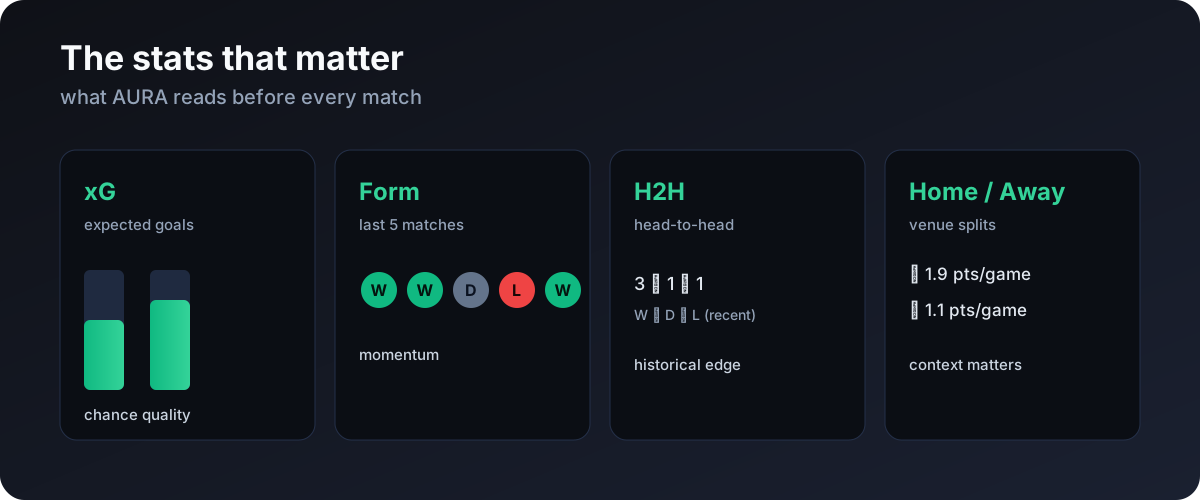
xG
The best single guide to chance quality. Compare to actual goals to spot teams riding their luck or due a turnaround.
Home/away splits
Among the most reliable edges in football. Always read a team's venue records separately, never blended.
Set pieces
A rising share of goals and a frequently overlooked weakness. Strong dead-ball teams punch above their open-play level.
Clean sheets
The simplest read on defensive reliability — cross-check against xG conceded to judge whether it will last.
AURA folds set-piece threat and clean-sheet frequency into its defensive and attacking estimates, both adjusted for venue and opponent. Because set pieces and clean sheets are often where matches are quietly decided, the engine treats them as meaningful signals rather than afterthoughts — while always expressing its conclusions as probabilities for information and entertainment.
Putting it all together: a reading checklist
How the metrics combine
No metric works alone. The skill is in layering them so they check and balance one another. xG tells you who created the better chances; form tells you about momentum and fitness; home/away splits tell you how venue reshapes the picture; shots and possession reveal the texture of the play; set pieces and clean sheets expose hidden strengths and weaknesses. When several independent signals point the same way, your confidence should rise. When they conflict, that conflict is itself information — usually a sign the scoreline has been flattering or hiding the truth.
| Metric | Reads best over | Primarily indicates | Common misread |
|---|---|---|---|
| xG / xG conceded | 6–10 matches (rolling) | Chance quality created and allowed | Over-reading a single noisy match |
| Recent form | Last 5–6, recency-weighted | Momentum, fitness, confidence | Ignoring opponent strength behind the run |
| Head-to-head | Most recent meetings only | Stylistic match-up patterns | Trusting old results with changed squads |
| Home/away splits | Full season, split by venue | Venue-driven strength and fragility | Blending into one combined number |
| Goals for / against | Full season + xG cross-check | Baseline attacking/defensive output | Mistaking lucky goal tallies for quality |
| Shots on target / in box | Rolling average | Threat building before goals arrive | Counting volume, ignoring shot quality |
| Possession | Per match, with final-third context | Style and territory, not quality | Equating more of the ball with deserving to win |
| Set pieces | Season, goals + volume | Reliable goal source / hidden weakness | Overlooking it because it isn't a headline stat |
| Clean sheets | Season, split by venue | Defensive reliability | Trusting clean sheets that mask high xG conceded |
This is the same philosophy that underpins AURA. The engine ingests these signals — opponent-adjusted, venue-split and recency-weighted — and combines them into a probabilistic view of how a match might unfold. It is designed to weigh underlying performance over flattering results, and to express uncertainty honestly. Every output is for information and entertainment, a statement of likelihood rather than certainty, and never a guarantee or an invitation to bet.
A final reminder on odds: throughout SportPicker, odds and implied probabilities are shown as information to help you understand how likely the market thinks an outcome is. They are educational context, not betting advice and not an invitation to wager.
Frequently asked questions
What is xG (expected goals) in simple terms?
xG assigns every shot a value between 0 and 1 representing the probability an average player would score from that situation, based on factors like distance, angle and how the chance was created. Adding up a team's chances gives a measure of how many goals their play was worth, independent of how many actually went in. It's the clearest single guide to chance quality, though it's noisy over a single match and best read across several games.
Which football stat is the most reliable for understanding a match?
There isn't one magic number. Rolling, opponent-adjusted xG is the strongest single indicator of underlying quality, and home/away splits are among the most durable edges. But the real value comes from reading several metrics together — when xG, form and shot quality all agree, your confidence should rise; when they conflict, that disagreement is itself a useful signal that the scoreline may be misleading.
Is possession a good way to predict who will win?
On its own, no. Possession describes a team's style and where the ball was held, not how well they played. Plenty of matches are won by the side with far less of the ball through counter-attacking. Always pair possession with chance-quality metrics like xG and shots inside the box before drawing any conclusion about who deserved to win.
How much should I trust head-to-head records?
Treat them as soft context, not a rule. Squads, managers and tactical identities change constantly, so a result from a few seasons ago tells you little about two largely different teams. Head-to-head data is most useful when the personnel have been stable and there's a clear stylistic clash — but current form and underlying numbers should always carry far more weight.
How does AURA use these statistics?
AURA combines these signals — xG, recency-weighted form, home/away splits, goals, shots, possession, set pieces and clean sheets — all adjusted for opponent strength and venue, into a probabilistic view of how a match might unfold. It deliberately favours underlying performance over flattering results. All output is for information and entertainment only, expressed as likelihoods rather than certainties, and never a guarantee or betting advice.
Why did a team win despite losing the xG battle?
Because the scoreline mixes underlying performance with luck. A side can lose the xG battle yet win through clinical finishing, a goalkeeper's heroics, a deflection or a single moment of quality. Over one match this happens often; over many matches, results tend to drift back toward the underlying numbers, which is why xG is so valuable for spotting teams likely to improve or decline.